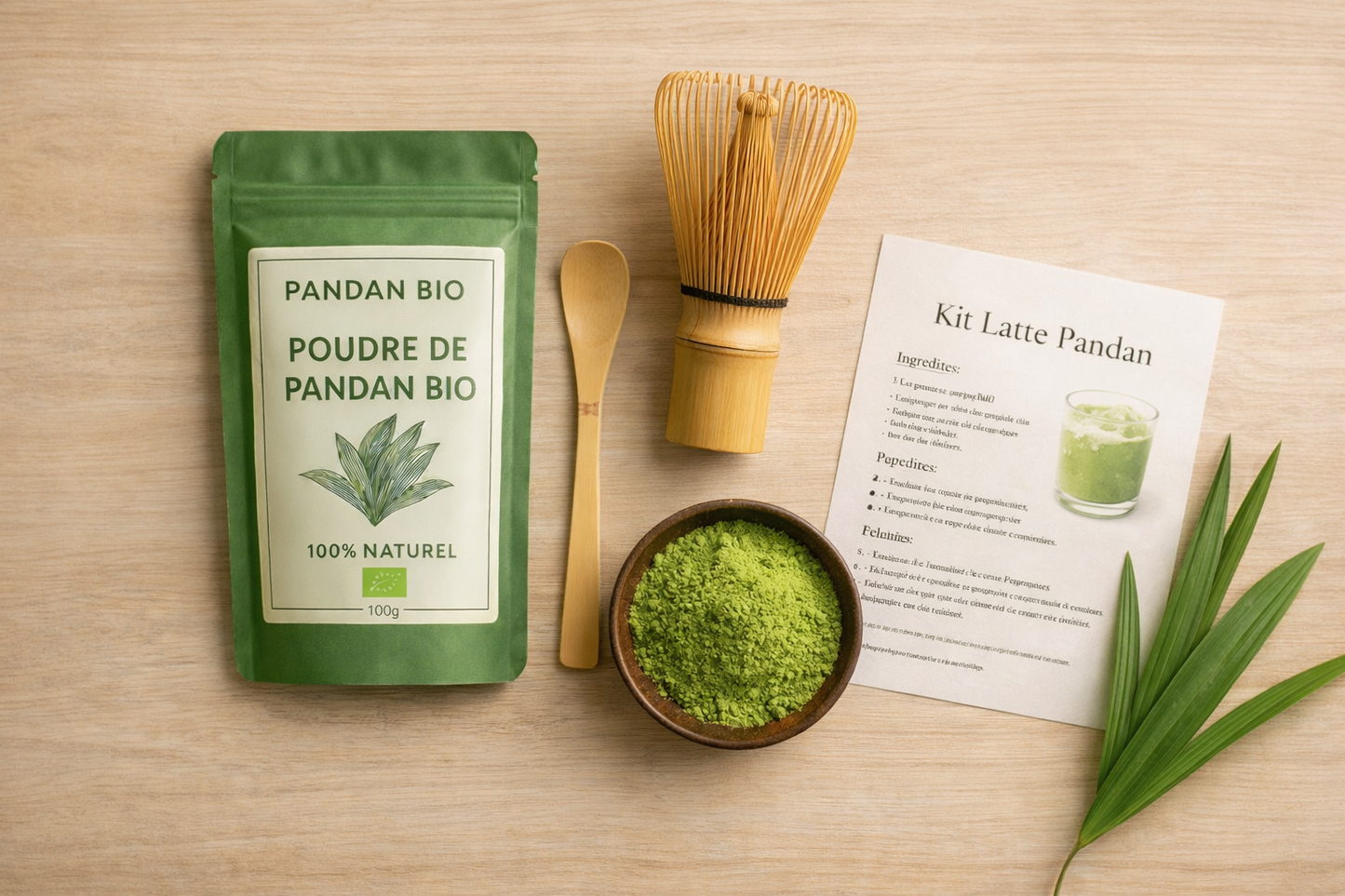
Fresh pandan leaves vs. pandan powder: the key differences
Pandan comes in various forms, but the most common are fresh (or frozen) leaves and pandan powder. If you’re new to this aromatic plant, you might be wondering which form to use in your recipes. In this article, we compare pandan leaves and pandan powder in terms of flavor, convenience, andculinary uses, to help you make the right choice without repeating information already available on our site.
Aroma and flavor intensity
Fresh pandan leaves give off a subtle, delicately sweet fragrance, often compared to a blend of vanilla and coconut. When steeped in a liquid (water, coconut milk, etc.), they release a mild but relatively light flavor. In contrast, pandan powder, made by grinding dried leaves, has a more concentrated aroma. It is slightly more herbaceous or earthy than the fresh leaves—so its flavor is more pronounced, while retaining pandan’s vanilla-like base. In practice, a small amount of powder is enough to flavor a dish, whereas several leaves would be needed to achieve the same effect.
It’s important to note that because of its high concentration, the powder can become bitter if you use too much. Fresh leaves, on the other hand, will never make a dish bitter, but their more subtle fragrance may go unnoticed in very spicy or rich recipes. In short, for an intense pandan flavor, the powder is more effective, while for a subtle and authentic aroma, the leaves work wonders (for example, in an infusion or flavored rice).
Availability and storage
In Europe, finding fresh pandan leaves isn’t always easy. You can sometimes find them in Asian grocery stores, in the fresh or frozen sections, but their availability remains limited. Furthermore, fresh leaves don’t keep well: even in the refrigerator or freezer, their fragrance fades over time. In contrast, pandan powder is now readily available through specialized online stores. Packaged in airtight bags, it has a long shelf life (several months) while retaining its aroma. The powder can be stored at room temperature without any issues, as long as it is kept away from light and moisture.
Another practical advantage of the powder is that it is available year-round and can be shipped easily. Fresh leaves, on the other hand, rely on air imports or very limited local cultivation, which explains their scarcity on the European market. Finally, it’s worth noting that dosing is more precise with the powder. A measuring spoon allows you to replicate the exact same flavor intensity every time, which is more difficult with leaves, whose size and aromatic concentration can vary.
Culinary Uses
Using fresh leaves: Pandan leaves are typically used to make an infusion. Rinse them, tie them in a knot (to release more aroma), and then steep them in a hot liquid. For example, adding a few leaves to coconut milk while cooking sticky rice will give it a delicate fragrance. After steeping, remove the leaves before serving the dish (much like you would remove a bay leaf). The leaves can also be used to wrap foods (meats, cakes) during cooking to infuse them with their fragrance, a traditional method in Thailand and Malaysia.
How to use the powder: Pandan powder is very easy to use, provided it is mixed in properly. Since it is fine but highly concentrated, it is recommended to first dissolve it in a little warm water or milk to create a smooth paste without lumps. You can then add it to the rest of the mixture (crepe batter, flan mixture, smoothie, etc.). This tip prevents “pockets” of poorly mixed powder and ensures a consistent flavor. The powder intensely colors mixtures green, resulting in visually playful desserts (e.g., green crepes, green marbled cake). For beverages, you can make “pandan tea” by steeping the powder in hot water and then straining it; drink it as is or as a base for a latte—though it will be slightly less floral than an infusion made from fresh leaves.
In baking, the powder blends well into doughs and creams, as long as you don’t use too much. Start with ½ teaspoon for 4 people, for example, then adjust the amount next time based on the desired intensity. Remember that the flavor of pandan powder can be surprisingly strong for something that looks so innocent. It’s better to use too little than too much, especially the first time.
Which size of pandan should I choose?
If you have access to fresh leaves and are looking for an authentic experience, don’t hesitate to try them in traditional recipes (infusions, flavored rice, etc.). The sensory experience of using the whole leaf is part of the joy of cooking with exotic ingredients. On the other hand, for regular, modern, and convenient use, pandan powder is often the best choice. It concentrates all the flavor of pandan into a practical, stable, and easily measurable form. Plus, the powder allows for creative recipes that would be impossible to make with the leaves (such as a pandan glaze, where the leaf couldn’t be incorporated).
In short, fresh leaves are best suited for purists and occasional use, while the powder is ideal for easily incorporating pandan into your daily cooking. To stock your “pandan pantry” without duplicates, keep in mind that each form has its own advantages: leaves for tradition, powder for innovation. The key is to use the right amount and adapt your method of use. And of course, be sure to choose high-quality organic pandan powder to fully enjoy the authentic fragrance of this plant.
Need some inspiration? With this powder, you can try out all sorts of pandan recipes —from lattes to desserts—and take your taste buds on a journey to Asia right from your kitchen. 🌿🥥 Enjoy the culinary adventure!